Stop Making These 7 Common Tajweed Mistakes Before Your Next Recitation
Is it possible that we, quite spontaneously, commit Tajweed mistakes that could alter the very essence of Allah’s words without even realizing it? This question strikes at the heart of our connection with the Creator’s words. Tajweed is, at its core, a protective shield that prevents the erosion of Quranic meanings over time, rather than an aesthetic embellishment seeking sensory appeal.Understanding tajweed rules is essential because it is the science that rejects “randomness” in pronunciation and requires a strict system for each letter; for every letter is a structural unit defined by precise coordinates of articulation and essential attributes.
At Josoor Al Quran, we cultivate the synergy between phonetic exactness and spiritual ascent. We believe that true mastery is the catalyst for revealing the eloquent symmetry of the Divine Revelation. By recognizing and correcting these 7 common Tajweed mistakes before your next recitation, we guarantee that your journey with the Quran reflects the accuracy, discipline, and quality required to honor its sacred melody.
As Allah commands in the Qur’an: “وَرَتِّلِ الْقُرْآنَ تَرْتِيلًا”
“And recite the Qur’an with measured recitation.” (Al-Muzzammil: 4). This Divine command establishes that Tartil (precision and deliberation) is the essential standard for approaching the Word of Allah.
This guide contains the precise corrections required to align your voice with the tajweed rules and standards of excellence championed by Josoor Al Quran.
Disruption of Articulatory Integrity
The most fundamental disruption in tajweed rules is shifting a letter’s articulation point, its distinct phonetic signature. Compromising this origin fails the letter’s structural integrity, risking a core alteration of the Divine Word.
Common Articulatory Deviations:
- Confusing ق (Qaf) with ك (Kaf).
- Mixing ص (Saad) with س (Seen).
- Weakening ع (Ayn) into a simple vowel sound.
The Correction:
Josoor Al Quran emphasizes deliberate, careful repetition and anatomical awareness. Anchoring each letter to its exact Makhraj restores the clarity and precision needed for an authentic Quranic sound.
Ignoring Proper Elongation Rules (Madd)
Madd rules govern vowel elongation, forming the rhythmic foundation of The Revelation of Allah. Ignoring these durations creates a fractured pace, compromising the architectural balance of the verse.
The Standards of precise durations:
- Natural Madd (Madd Asli): 2 counts.
- Obligatory Madd (Madd Wajib): 4–5 counts.
- Necessary Madd (Madd Lazim): 6 counts.
The Correction:
Rhythmic consistency needs a controlled internal pulse. At Josoor Al Quran, we train reciters to maintain equal durations whenever a specific Madd appears. By applying these tajweed rules precisely, you ensure that the recitation retains its spiritual cadence and structural poise.
Phonetic Fluidity: Noon Sakinah and Tanween
The rules of Noon Sakinah and Tanween serve as catalysts for phonetic fluidity in Allah’s Revelation. Neglecting them results in rigid, mechanical recitation, which disrupts the smooth interaction of words.
- Izhar (clear pronunciation).
- Idgham (merging).
- Iqlab (conversion).
- Ikhfa (partial concealment).
Mistakes such as over-clarifying the Noon in Ikhfa or failing to complete the Idgham merge disrupt the eloquent symmetry of transitions. These inaccuracies disrupt the recitation’s natural phonetic flow.
The Correction:
At Josoor Al Quran, we cultivate anticipatory awareness to ensure phonetic grace. By proactively identifying subsequent letters, students achieve temporal exactness, allowing the vocal tract to transition seamlessly within The Revelation of Allah.
Weak or Missing Ghunnah (Nasal Sound)
The Ghunnah is more than just an addition; it is the ambient heartbeat of Quranic phonetics. This distinct nasal resonance imparts the depth and “melodic resonance” that distinguishes an elite recitation. Clipping this sound diminishes the richness and structural beauty of The Sacred Verse.
The primary occurrences of resonance are:
- Noon Mushaddad (نّ).
- Meem Mushaddad (مّ).
- Certain Ikhfa and Idgham situations.
A common mistake is shortening or eliminating the Ghunnah, resulting in an incomplete pronunciation.
The Correction:
Josoor Al Quran emphasizes the equilibrium of resonance. Allow the nasal sound to fully resonate, without exaggeration or reduction. Mastering this temporal exactness ensures that your recitation has the weight and elegance intended by the creator’s proclamation
Tonal Disparity: Tafkheem and Tarqeeq
The Qur’an’s phonetic landscape distinguishes letters by ‘weight’; the contrast between Tafkheem and Tarqeeq creates a vital dynamic range. Failing to differentiate these weights renders the recitation flat and monotonous, stripping the timeless revelation of its character.
Emphatic Amplification (Tafkheem): Elevating the rear tongue to create a deep, resonant chamber for heavy letters.
Subtle Attenuation (Tarqeeq): Maintaining a lowered tongue posture for light, precise letters to prevent vocal spillover.
A common mistake is over-heaviness or excessive softness where it does not belong.
The Correction:
Josoor Al Quran‘s emphasis on the natural weight of each letter teaches trust in addition to phonetics.You are carrying the words exactly as they were revealed, ensuring that the bridge between generations remains intact.
Stopping Incorrectly (Waqf) and Starting Incorrectly (Ibtida)
Waqf and Ibtida represent the Qur’an’s narrative architecture, ensuring meanings remain intact. Incorrect pauses disrupt the eloquent symmetry and sever logical connections, compromising the conceptual integrity of Allah’s message.
Common mistakes include:
- Stopping where continuation is required
- Continuing where stopping is necessary
- Restarting in a way that alters meaning
The Correction:
At Josoor Al Quran, we cultivate a profound contextual awareness. You must recognize the symbolic markers and comprehend the breath-management techniques required for long verses. You can maintain the clarity and structural control of your recitation by pausing only when necessary and completing it with purpose.
Rushing Through Recitation Without Measured Pace
Excessive speed is the primary cause of phonetic failure. A rushed pace compromises articulatory integrity and reduces The Heavenly Communication to a mechanical exercise, stripping the words of their intended majesty and profound impact.
The Prophetic Standard: The Sunnah of recitation is distinguished by clarity, deliberation, and measured rhythm. Every letter must be given its full right and proper attribute , resulting in a distinct and complete phonetic profile.
Abu Lubabah Bashir bin ‘Abdul-Mundhir (May Allah be pleased with him) reported: The Prophet (ﷺ) said, “He who does not recite the Qur’an in a pleasant tone is not of us.” [Abu Dawud].
The Correction:
At Josoor Al Quran, we advocate for a ‘contemplative pace,’ slowing the delivery until every elongation and resonance is perfectly applied. This measured cadence synchronizes the heart and tongue, facilitating the spiritual ascent sought by the true tajweed rules.
Practical Steps to Eliminate Tajweed Mistakes Permanently
1. Daily Letter Practice :
Josoor Al Quran specializes in determining the precise exit points (Makharij) for letters.
- The Josoor Edge: Use their one-to-one sessions to have a teacher pinpoint exactly where your tongue or throat placement may be incorrect.
- Spend 5 minutes before your lesson focusing on the “Heavy” letters (خ, ص, ض, ط, ظ, غ, ق) to increase strength.
2. Slow and Measured Recitation :
Reciting slowly is the only way to “see” the rules before saying them.
- The Josoor Edge: Have your tutor lead a Tahqeeq-style session. This slow pace allows the teacher to detect “micro-mistakes” in vowel lengths (Harakat), which are often missed at normal speeds.
3. Consistent Rule Application:
Consistency emphasizes discipline over speed.
- The Josoor Edge: Josoor’s curriculum frequently aims to teach one rule (such as Ghunnah or Qalqalah) before heading to the next.
- Tell your Josoor teacher, “Today, focus entirely on my application of tajweed rules regarding Madd lengths.” Giving them permission to be meticulous will accelerate your progress.
4. Active Listening & Self-Correction:
You can’t fix something you can’t hear.
- Record your Josoor Al Quran session. Listen to the teacher’s correction, then listen to your own attempt right after. Contrast is the most successful method of instruction.
A Quick Tip on “Permanent” Elimination
Mistakes frequently resurface when we are tired or rushed. To make your progress permanent, follow The Rule of Three: if you make a mistake, stop and correct the word or phrase three times in a row before continuing. This replaces the wrong neural path with the right one.
Signs That Tajweed Is Being Applied Correctly
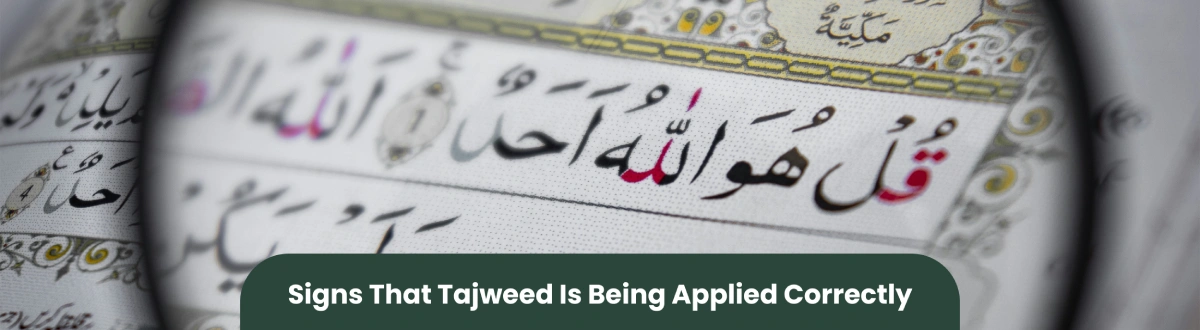
We know tajweed rules is properly applied when:
- The letters sound distinct and clear.
- Elongations remain consistent.
- Nasal sounds are accurate.
- Heavy and light letters are balanced.
- Recitation goes smoothly and without hesitation.
These indicators demonstrate disciplined and accurate recitation.
The Long-Term Impact of Eliminating Tajweed Mistakes With Josoor Al Quran

- Improves pronunciation accuracy:Each letter is pronounced clearly from the correct articulation position.
- Strengthens recitation confidence : We recite without hesitation, uncertainty, or fear of making mistakes.
- Improves fluency and smooth flow :Recitation becomes more balanced, natural, and simple to do.
- Preserves the Qur’anic wording :Correct tajweed rules protect the original pronunciation and meaning.
- Improves consistency in applying Tajweed rules : elongations, nasal sounds, and letter characteristics remain consistent.
- Reduces mistakes over time: Consistent practice makes proper recitation natural.
- Develops complete recitation control :we maintain the proper pace, clarity, and preciseness.
Perfect Tajweed Begins with Eliminating These Common Mistakes
A strong Tajweed foundation transforms recitation into a clear, accurate, and confident expression of every letter and sound. With proper guidance and consistent practice, mistakes gradually disappear and precision becomes natural. Through structured learning at Josoor Al Quran, we develop the skills, discipline, and confidence needed to achieve refined recitation and lasting tajweed rules mastery.
Correct Recitation Starts Here! Get a free level assessment and a Tajweed trial session with expert tutors at Josoor Al Quran.
https://josooralquran.com/free-online-test/
Contact Us:
Email: info@josooralquran.com
WhatsApp: (+966 57 209 4056 )
Frequently Asked Questions:
- Can vocal muscles become accustomed to mistakes? How does Josoor address this?
Yes, what we call “muscle memory” can cause the tongue to default to incorrect pronunciation due to years of repetition. At Josoor Al Quran, we go beyond the theoretical corrections. We employ “tongue resetting” exercises that entail isolating the letter and repeating it in various states (Sakin, Mutaharrik, Mushaddad) until the muscle replaces the previous habit with the correct articulation position.
- How can I distinguish between Clear Mistakes (Lahn Jali) and Hidden Mistakes (Lahn Khafi) during my solo practice?
A clear mistake is an error in the word’s structure (such as changing a vowel) that alters its meaning. A Hidden Mistake refers to a lack of perfection in attributes. During your trial session, we will provide a “Self-Checklist” to assist you in identifying these nuances in your daily recitation.
- Does mastering Arabic articulation points affect the pronunciation of other languages, or vice versa?
On the contrary, mastering tajweed improves vocal flexibility. We assist students, whether they are non-native speakers or have strong local dialects, in isolating the Quranic phonetic system. This ensures that your recitation retains its “phonetic purity” and is unaffected by the accents of everyday speech.
- I find it hard to balance thinking about rules with feeling the spiritual meaning.What is the solution?
This is a very common challenge. At Josoor Al Quran, we use the “Gradualism to Subconsciousness” methodology. Our goal is to transfer tajweed rules from the analytical mind to the subconscious, so that they flow as naturally as breathing. This allows your heart and mind to focus on only contemplating its true meanings.
- Does the academy provide a specific curriculum for those who struggle with breath control in long verses?
Absolutely. “The Art of Breath Management” is an essential component of our training. We teach students about elective Stopping and Starting (Waqf and Ibtida) points, including how to distribute your breath across a verse without sacrificing vocal beauty or meaning integrity.